Why 4G Is Running Out of Road at Ports and Warehouses
For most of the last decade, 4G LTE was more than adequate for transportation logistics. A dispatcher tracking a handful of trucks, a warehouse with a few dozen barcode scanners, a port office pulling vessel schedules — none of that stressed the network. What has changed is the sheer number of connected devices a modern logistics operation now runs simultaneously: hundreds of IoT sensors on pallets and containers, dozens of automated guided vehicles moving in a coordinated pattern, cameras running real-time computer vision on every inbound truck, and telematics units streaming continuous data from an entire fleet. 4G networks were architected for a world with far fewer devices per cell and far more tolerance for a few hundred milliseconds of lag. Neither of those assumptions holds up in a modern container terminal or fulfillment center, and that gap is exactly what 5G logistics infrastructure has been built to close.
What 5G Actually Adds: Latency, Density, Bandwidth
The three technical properties that matter most for transportation logistics are latency, device density and bandwidth, and 5G improves on 4G meaningfully on all three. Latency — the delay between a command being sent and a device acting on it — drops from the tens of milliseconds typical of 4G to single-digit milliseconds on a well-configured 5G network, which is the difference between an automated crane responding to an operator's input in real time versus with a perceptible, potentially unsafe lag. Device density is arguably even more important for logistics specifically: 5G networks are designed to support roughly a million connected devices per square kilometer, compared to a few thousand for 4G, which is what makes it practical to put a sensor on every pallet, container and piece of yard equipment in a busy facility without the network buckling under the load. Bandwidth gains on top of that support higher-resolution video feeds for computer-vision cargo inspection and faster synchronization of the digital twins increasingly used to model port and warehouse operations.
Private 5G Networks Are Where the Real Deployment Is Happening
The most consequential 5G logistics deployments are not on public carrier networks at all — they're private 5G networks built and controlled by a single port, terminal operator or distribution company. A private network gives that operator guaranteed bandwidth and predictable latency for mission-critical automation, along with direct control over security, rather than sharing capacity with everyone else's phones and data plans in the same cell. The Port of Tyne in the UK has deployed private 5G across its roughly 620-acre site with support from BT and Ericsson, using the network to support edge computing, AI-driven monitoring and drone operations across port infrastructure. The Port of Santos in Brazil has taken a similar approach, using a private 5G network to unify previously siloed data streams — radar, camera networks, environmental sensors — into a single operational picture for port authorities. Hamburg's long-running DigiTest initiative has used the port as a live testbed for private cellular logistics applications since 2020, with new projects continuing to launch on that infrastructure. These are not pilot demonstrations anymore; they are production networks handling real cargo movements every day.
4G vs. 5G for Core Logistics Use Cases
| Use Case | 4G LTE | 5G (Private/Dedicated) |
|---|---|---|
| Autonomous yard crane / vehicle control | Latency often too high for safe real-time control | Sub-10ms latency supports real-time operation |
| Warehouse-wide IoT sensor network | Network congestion above a few thousand devices | Supports very high device density per cell |
| High-resolution cargo video inspection | Limited bandwidth for multiple 4K streams | Handles many concurrent high-resolution feeds |
| Rural highway fleet tracking | Widely available, adequate for basic GPS pings | Coverage still limited outside dense/industrial areas |
What This Means Inside the Warehouse
Distribution centers are adopting 5G, and increasingly private 5G specifically, for many of the same reasons ports are: Wi-Fi networks struggle with the device density and reliability that dense automation requires, particularly when automated mobile robots and forklifts are moving continuously and need uninterrupted connectivity as they roam between access points. A 5G network handles that handoff between coverage zones more gracefully than Wi-Fi, which matters when a robot losing connection mid-task can stall an entire pick line. This connects directly to the broader shift toward IoT-driven visibility we cover in our guide to real-time cargo tracking — 5G is frequently the connectivity layer underneath those IoT sensor networks, providing the bandwidth and reliability that make dense, real-time tracking practical at facility scale rather than only at the level of individual high-value shipments.
Fleet Telematics and the Coverage Gap That Remains
For over-the-road fleets, 5G's impact has been more uneven than at fixed facilities, because network build-out has concentrated in cities, ports and industrial corridors rather than along the full length of every trucking route. A fleet operating within a metro area or moving between 5G-connected ports and distribution hubs sees real benefits in telematics data resolution and responsiveness, a topic we explore further in our piece on fleet telematics for transportation logistics. But long rural stretches between those hubs often still rely on 4G LTE, and in genuinely remote corridors, satellite connectivity fills the gap entirely. That unevenness is a realistic planning consideration rather than a flaw: it means 5G's biggest near-term impact on transportation logistics is concentrated at the nodes — ports, terminals, warehouses — rather than continuously along every mile of a route.
Smart Terminals: 5G as Automation Infrastructure
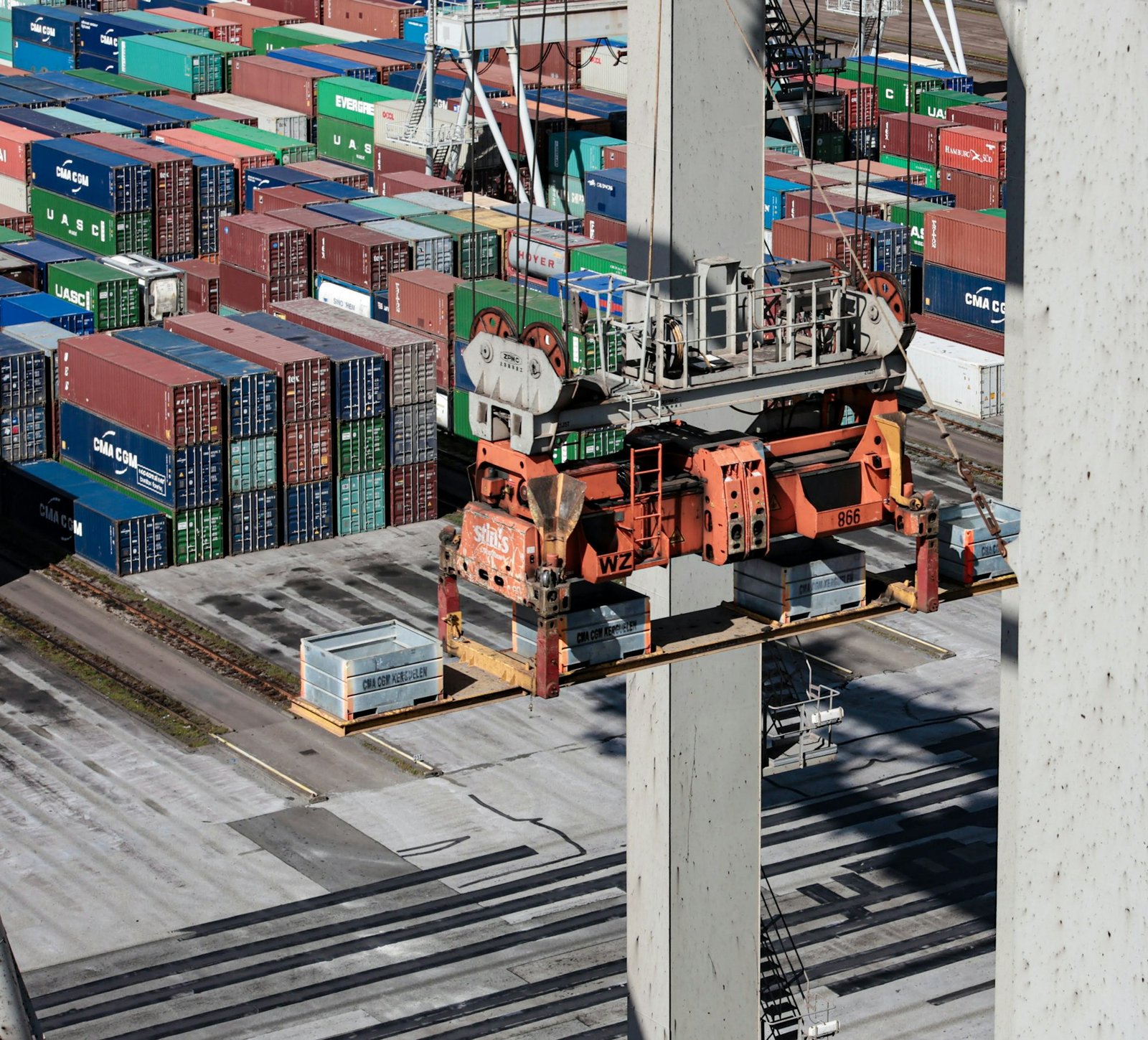
Container terminals that have automated crane operations, gate processing and yard equipment coordination depend on exactly the kind of low-latency, high-density connectivity that 5G is built to provide, which is why the rollout of smart terminal automation and the rollout of private 5G at major ports have moved forward together rather than separately. Our overview of port automation and smart terminals goes into more detail on how these automated systems function; 5G is best understood as the connective tissue that makes that automation reliable enough to run continuously rather than a stand-alone technology story on its own. Ports that have made this transition have reported handling meaningfully more container volume with the same or smaller labor footprint, a productivity gain that flows through to faster vessel turnaround and, ultimately, more predictable transit times for the cargo moving through those terminals.
Where Transportation Logistics Goes From Here
The realistic picture for 2026 and beyond is one of uneven, deliberate rollout rather than a sudden network-wide upgrade. Private 5G is becoming close to standard at major ports and large-scale automated distribution centers, where the return on investment from tighter automation and higher container throughput is clear and immediate. Public 5G continues to expand along dense urban and industrial corridors, gradually improving fleet visibility in those areas even without a shipper or forwarder needing to do anything differently. What has not changed, and won't change quickly, is coverage along the long rural and cross-border stretches that make up a large share of total freight mileage — which is exactly where hybrid connectivity strategies combining cellular and satellite technology, similar to those discussed in our piece on satellite IoT tracking for remote supply chains, continue to matter. For a company managing multimodal transportation logistics across China, India, Turkey and the wider network RR Brothers and Logistics serves, tracking where 5G infrastructure is actually deployed — versus where it is merely announced — is part of building routing and partner decisions on solid ground rather than marketing claims.
The Cost and Spectrum Realities Behind the Rollout
None of this is free or instant, and it's worth being clear-eyed about why 5G logistics infrastructure has rolled out unevenly rather than everywhere at once. Building a private 5G network requires spectrum access — either licensed spectrum a port or operator secures directly, or shared/unlicensed bands depending on the country's regulatory framework — along with the small-cell radio hardware, edge computing servers and integration work needed to connect it to existing terminal operating systems. That is a capital-intensive undertaking that only makes clear financial sense at facilities with enough automation and device density to justify it, which is exactly why deployment has concentrated at major ports and large distribution hubs rather than spreading evenly across the industry. Smaller terminals and warehouses are more likely to lean on public 5G, upgraded Wi-Fi 6, or a mix of both for the foreseeable future, which means the connectivity a shipment experiences can vary meaningfully depending on which facilities it passes through — one more reason working with a forwarder that understands the infrastructure at each node in a route, rather than assuming uniform technology everywhere, matters for realistic transit planning.
How RR Brothers and Logistics Can Help
RR Brothers and Logistics works with port terminals, carriers and warehousing partners across our network, which means our clients benefit indirectly from the private 5G and automation investments those facilities are making, without needing to manage or understand the underlying technology themselves. Whether your cargo is moving through an automated terminal with 5G-connected crane operations or a distribution center running dense IoT tracking, our team's job is to translate that infrastructure into reliable transit times and accurate visibility for your shipment. If you're planning freight movements through ports or hubs where connectivity and automation levels vary, our warehousing and distribution and sea freight teams can help you route around the gaps rather than discover them mid-shipment.
Frequently Asked Questions
5G offers substantially lower latency, far higher device density per cell, and greater bandwidth than 4G LTE, which matters for use cases like coordinating autonomous yard equipment in real time or connecting thousands of individual warehouse sensors on one network without congestion.
A private 5G network is a dedicated cellular network built and controlled by a single organization rather than a public carrier, giving a port or distribution center guaranteed bandwidth, predictable latency and control over security, which public networks shared with the general population cannot reliably offer for mission-critical automation.
Not consistently. 5G deployment has concentrated in dense urban areas, ports and industrial sites, while many rural highways and remote corridors still rely on 4G LTE or, in some cases, satellite connectivity for fleet tracking.
Generally no direct action is required. The benefits — faster terminal turnaround, more accurate tracking data, tighter automation at ports and warehouses a shipper's forwarder uses — flow through to the shipper as better visibility and reliability rather than requiring any change on the shipper's side.