
Taiwan to Russia shipping depends first on Taiwan's own export rules. Since March 2022 Taiwan has monitored exports to Russia and Belarus, and it has added items to its control lists in stages. A forwarder can quote a freight rate in an hour, but whether the goods may leave Taiwan at all is decided by a licence, and the published routes of the main Russian Far East container operator do not name a Taiwanese port. This guide goes through the control lists as the sources describe them, the licensing logic, the reshipment concern, the routing position and the Russian customs documents that follow. Please read it as orientation and take advice before booking; the lists change.
Short answer: exporters of the controlled high-tech goods need a licence from Taiwan's Bureau of Foreign Trade, and the licence decision looks at end use and end user. The route itself has to be confirmed with a carrier, because the FESCO route pages we read do not name Taiwan.
How Taiwan's Control Lists Were Built Up
Two sources give the sequence. Baker McKenzie's post of 13 January 2023 covers the early lists, and the Taipei Times of 8 February 2024 covers the machine-tool addition.
| When | What the sources say |
|---|---|
| From 1 March 2022 | Taiwan monitors exports to Russia and Belarus (Baker McKenzie) |
| April and May 2022 | 57 products in Categories 3 to 9 restricted (Baker McKenzie) |
| Announced 4 January 2023 | 52 new entries covering nuclear energy and other commodities, materials and chemicals, and tools and machinery, in Categories 0, 1 and 2 (Baker McKenzie) |
| Announced February 2024, effective 8 March | 77 machine-tool items added, described as CNC machine tools, machining centres, lathes, milling machines and grinding machines (Taipei Times) |
The Taipei Times says the ministry's aim was to bring the restrictions in line with sanctions from the EU, the US and Japan. Because the lists were extended in three steps between 2022 and 2024, a classification that was clear in 2022 may have changed, so check the current official list for each item.
Licences and End Use
According to Baker McKenzie, exporters of the listed goods must first apply to the Bureau of Foreign Trade of the Ministry of Economic Affairs for a Strategic High-Tech Commodities export licence. The post says the Bureau decides on the product's end use and on whether the end user is engaged in large-scale weapons proliferation where the exporter had received payment before the 2023 expansion; otherwise the regulator "will, in general, reject the application."
That is a January 2023 reading by a law firm. It does not replace the current rules, but it shows the shape of the question. The decision turns on who uses the goods and for what, not only on the item, so an exporter needs end-user details before applying, and a forwarder should expect to be asked for them.
Reshipment Risk: Why Intermediate Consignees Matter
The Taipei Times adds a point that matters to forwarders. Separately from the list, the ministry said it has requested Taiwanese manufacturers exporting to countries such as Turkey and the United Arab Emirates, which are considered to have a high risk of reshipping the products, to agree not to redirect shipments to Russia and Belarus. The sources do not give the number of manufacturers that agreed, so only the request is reported here.
For a booking, the lesson is that the first consignee is not the end of the screening. If the buyer is a distributor in a third country, ask where the goods are going next, put the end-use statement in writing, and keep it with the shipment file. The wider screening process is covered in sanctions and compliance in logistics to Russia.

How Large Is the Machine-Tool Slice?
The Taipei Times gives two numbers that can be combined. Taiwan's exports of the 77 machine-tool items to Russia reached US$45 million in 2023, which the article says was 1.47% of Taiwan's total exports to Russia.
- If US$45 million is 1.47% of the total, the total is about 45 divided by 0.0147, or roughly US$3.06 billion.
- The remaining 98.53% is not the 77 items, but it is not free of rules either: the earlier lists cover other categories.
So the 2024 addition covered a small share by value of what Taiwan sent to Russia in 2023. A small share does not by itself mean a light compliance load for the exporter of those items.
Routing: What FESCO's Pages Do and Do Not Say
FESCO's cargo page for the Commercial Port of Vladivostok lists China, Vietnam, Japan, Korea and Southeast Asia as origins. The route headings on its FCDL, JTSL, KSDL and FIAS line pages name ports in mainland China, Vietnam, Japan, Korea, Malaysia and Thailand. None of the four names a Taiwanese port.
That is not proof that no routing exists. Cargo could be loaded onto another carrier's service or moved through a hub, and other operators may publish different networks. It does mean that a quotation for this lane should state the load port, any transhipment port, the carrier on each leg and the discharge port, and that those details should be confirmed in writing before the booking is accepted.
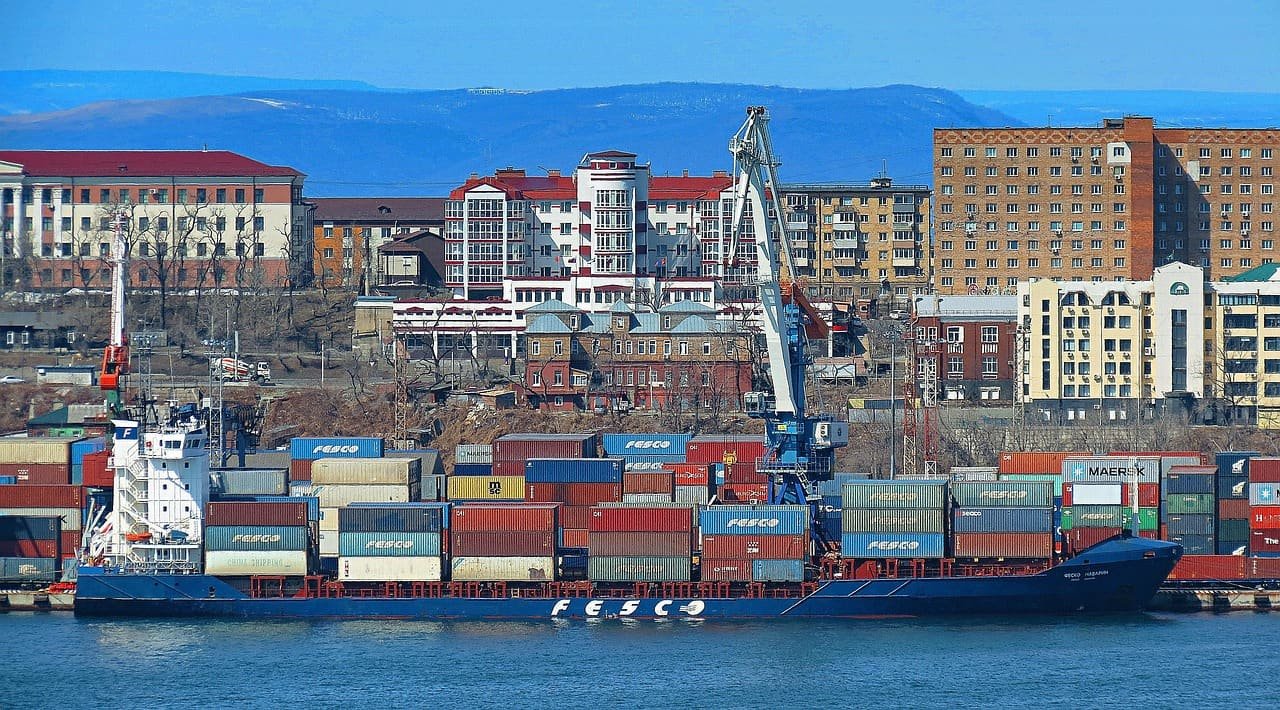
For the port itself, see Vladivostok Port: Russia's Far East Gateway for India Trade.
Russian Customs: Declarations and Supporting Documents
Two articles of the unofficial English translation of the EAEU Customs Code frame the Russian side. Article 105 lists the types of declaration: a declaration for goods, a transit declaration, a passenger customs declaration and a declaration for a vehicle. It says the data to be stated in a declaration is limited to what is needed to calculate duties, apply trade remedies, prepare statistics, control compliance with prohibitions and restrictions and protect intellectual property rights.
Article 108 lists the documents that confirm the declared data, including documents confirming compliance with prohibitions and restrictions, origin documents and documents confirming the customs value. Those relate to Russian and Union rules. A Taiwanese export licence is a separate matter at the origin end, so keep both sets of papers and do not assume one covers the other.
This translation predates later amendments to the Code, so a Russian customs broker should confirm what applies now. If your cargo is delayed at the border, the causes in common reasons for customs clearance delays are a useful checklist.
Booking Checklist
- Classify each item against the current Taiwanese control lists, not the 2022 or 2023 versions.
- If an item is listed, confirm the licence position with the Bureau of Foreign Trade before asking for a rate.
- Record the end user and the end use in writing, and ask where the buyer sends the goods next.
- Screen the buyer, consignee and intermediaries, and keep the record.
- Obtain the load port, transhipment port, carrier and discharge port in writing.
- Confirm who files the Russian declaration and which supporting documents are needed.
- Compare quotes of equal scope; our guide on choosing a freight forwarder lists questions to ask.
Work With RR Brothers and Logistics
RR Brothers and Logistics is an NVOCC headquartered in Guangzhou. The sea freight page lists Chinese gateways and destinations in India, Europe, the US and Canada, and it does not list Taiwan or Russia, so this guide carries no schedule or price for the lane. The customs clearance page covers HS-code classification, declaration and document checks. To find out what is possible, share the cargo, load port and consignee location, and we will reply with whether and how we can help once sanctions and export-control screening is done.
Frequently Asked Questions
Yes. Baker McKenzie reported that Taiwan has monitored exports to Russia and Belarus since 1 March 2022, restricted 57 products in April and May 2022, and added 52 entries in January 2023. The Taipei Times reported 77 machine-tool items added with effect from 8 March 2024.
According to Baker McKenzie, exporters apply to the Bureau of Foreign Trade of the Ministry of Economic Affairs for a Strategic High-Tech Commodities export licence. Confirm the current procedure with the Bureau.
The post describes a decision based on end use and on whether the end user is engaged in large-scale weapons proliferation for some orders, and says the regulator "will, in general, reject the application" otherwise.
It reports that the ministry requested Taiwanese manufacturers exporting to countries such as Turkey and the United Arab Emirates, which are considered to have a high risk of reshipping the products, to agree not to redirect shipments to Russia and Belarus.
The FCDL, JTSL, KSDL and FIAS pages we read do not name a Taiwanese port in their route headings. Confirm any Taiwan routing with the carrier in writing.
Our sea freight page lists Chinese gateways and does not list Taiwan or Russia. Send your cargo details and we will advise whether and how we can handle it.
Sources
- Baker McKenzie: Taiwan expands the list of export control items to Russia and Belarus (13 January 2023)
- Taipei Times: report on added machine-tool export restrictions for Russia and Belarus (8 February 2024)
- FESCO: Delivery of cargo via Commercial Port of Vladivostok
- FESCO: China Direct Line (FCDL) page
- FESCO: Marine transportation from Japan to Vladivostok (JTSL)
- FESCO: KSDL line page (Busan and Vladivostok)
- FESCO: FIAS line page
- Treaty on the Customs Code of the Eurasian Economic Union (unofficial English translation)
This article is general information, not legal, tax or customs advice. Rules, rates and procedures change; confirm current requirements with the relevant authority or a licensed customs professional before you ship. The points above were taken from the pages listed under Sources, which include a law-firm post, a newspaper report, operator pages and an unofficial translation, read on 29 October 2026. The Taiwanese lists are described as reported in 2023 and 2024 and have not been re-checked against the current official lists, so confirm current rules with the relevant authority.
Image credits: header photo by Timelab on Unsplash; photo by Jakub Żerdzicki on Unsplash; photo from zzkonst on Pixabay. Used under the Unsplash License and the Pixabay Content License.
Request a Quote