Japan to Russia shipping can run as a sea-and-rail route. Containers can leave a Japanese port, cross the Sea of Japan to Vladivostok and continue inland by rail, with Japanese export rules to clear at one end and Russian customs rules at the other. This guide uses published sources to set out the trade picture, what FESCO publishes about its Japan line, the Japanese measures to check before a booking, and how advance declaring and classification work under the Eurasian Economic Union (EAEU) Customs Code. A worked example then compares a direct call with a feeder routing. It is general information, not legal advice, and rules in both countries change.
Short answer: FESCO's published Japan line calls at Yokohama, Nagoya, Kobe and Toyama on its way to Vladivostok, with other Japanese ports reached by feeder through Busan on request. Whether your goods may be exported at all depends on Japan's export bans, which come first.
Japan to Russia Trade: What the Ministry of Finance Data Show
TASS, calculating from Japanese Ministry of Finance statistics, reported that trade between Japan and Russia in fiscal year 2025, April 2025 to March 2026, was about 1.21 trillion yen ($7.6 billion), up 3.84% on fiscal 2024. Liquefied natural gas was 57.1% of Russian imports to Japan. On the export side, automobiles and vehicle components were 60.4% of Japanese exports to Russia.
Two cautions apply. The figures are TASS calculations, so quote them with that attribution. And the shares describe what moved in value, not the mix of containers on any one sailing. The useful point for a shipper is that vehicle goods account for a large part of what Japan sends, and engines and parts of special vehicles appear in the Japanese measure described below.
The Sea Leg: Japanese Ports to Vladivostok
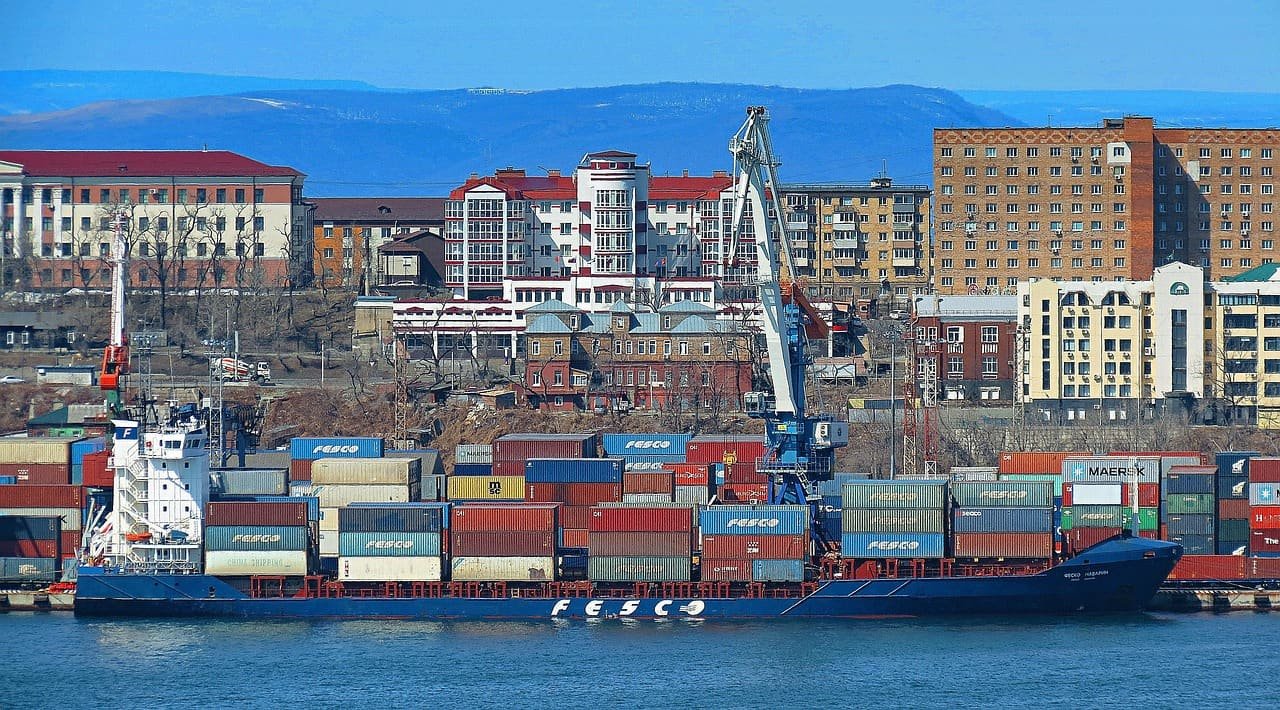
FESCO's cargo page for the Commercial Port of Vladivostok says it delivers containerized cargo from Japan, among other origins, via Vladivostok to any destination in Russia and the CIS, and names its Japan line as JTSL. It also says that, on its own assets, it organizes accelerated container trains, an average of 30 to 40 per week, from Vladivostok. The JTSL page adds the detail below.
| Item | What the page says |
|---|---|
| Route heading | Vladivostok, Yokohama, Nagoya, Kobe, Toyamashinko, Vladivostok |
| Ports in the About section | Toyama, Yokohama, Kobe, Nagoya and Hakata to Vladivostok |
| Direct service | Direct service from 4 Japanese ports to Vladivostok |
| Other Japanese ports | Shipment from over 30 Japanese ports via Busan, on request, through partner feeder lines |
| Frequency | Described as a regular schedule; no number of sailings is given |
| Day counts | Yokohama 9, Nagoya 8, Kobe 7, Toyama 2, but the page does not say what they measure |
The page is not fully consistent. It spells the fifth port of the route heading as Toyamashinko while the About section says Toyama, and Hakata appears in the About section but not in the route heading. That is a reason to ask for the dated schedule and the named load port in writing, not to rely on a web page.
For what the port offers once the box arrives, see Vladivostok Port: Russia's Far East Gateway for India Trade.
Japan's Export Controls: Check These Before You Book
Baker McKenzie's Tokyo office, in a post dated 19 January 2025, summarised Japan's further sanctions against Russia. It says the measures were taken under the Foreign Exchange and Foreign Trade Act, based on a Cabinet Understanding dated 10 January 2025, and describes three layers.
- Designated entities: an export ban on Russian and Belarusian designated entities, covering all items except an exempted category the post describes, with 559 designated Russian entities and 27 Belarusian ones as at that date.
- Third-country entities: an export ban on designated entities in third countries, which the post lists as including the UAE, Armenia, China, India, Kazakhstan, Kyrgyzstan, Syria, Thailand, Turkey and Uzbekistan, for goods in the Russia export-ban annex.
- Industrial base: a ban on the export of 335 items, which the post describes as including engines and parts of special vehicles, small motor bicycles, audio devices and machine tools, followed by a list of HS codes.
The post is dated and has some inconsistencies in its own counts, so treat it as a pointer to the official texts, not a replacement. The Japanese lists have changed more than once, and a consignee that appears on a list can stop a booking even if the goods themselves are unrestricted. For how screening fits into a booking, read sanctions and compliance in logistics to Russia. Nothing here is advice on avoiding any control.
Vehicles and Parts: Classification Comes First
Because vehicles and parts are such a large share of what Japan sends, and the post says the 335-item measure includes engines and parts of special vehicles, the first check for an automotive consignment is the exact HS classification of each part number against the current Japanese lists. The measure is expressed as HS-coded items, so a chapter heading alone is not enough. Keep the classification, the supplier's technical sheet and the end customer's details together, because Russian customs can ask for classification evidence as well.
Russian Customs: Declaring Before Arrival and Classification Evidence
Three parts of the unofficial English translation of the EAEU Customs Code bear on a sea shipment that arrives at Vladivostok. It dates from the treaty of 11 April 2017 and has been amended, so confirm current wording with a Russian customs broker.
- Preliminary declaring (Article 114): the declaration can be submitted before the goods arrive. It carries the data of a normal declaration except items that cannot be known in advance, such as vehicle details and separate supporting documents. After arrival by vessel, the declarant tells customs that the goods are at the point of entry named in the declaration.
- Changing declared data (Article 112): with customs consent, data can be changed before release, but not once customs has requested documents, announced an examination or started an inspection, apart from limited corrections such as typographical errors and the location of the goods.
- Classification evidence (Article 108): the documents that confirm declared data include those confirming the characteristics of goods used to classify them under the Commodity Nomenclature of Foreign Economic Activity, and an advance ruling on classification if one exists.
The practical reading is that mistakes are cheapest to fix before customs starts asking questions. The part number, description and classification should match across the invoice, the packing list and the declaration. For the general causes of border delay, see common reasons for customs clearance delays.
Direct Call or Feeder via Busan: A Worked Comparison
All figures here are invented. Suppose a consignee needs one 40 ft container of parts from a Japanese port that has no direct call, and compares two routings.
| Line | Direct call from a main port | Feeder via Busan from a smaller port |
|---|---|---|
| Feeder leg to Busan | not applicable | USD 450 |
| Transhipment handling at Busan | not applicable | USD 140 |
| Ocean freight to Vladivostok | USD 1,400 | USD 1,100 |
| Origin port charges | USD 180 | USD 160 |
| Vladivostok port charges | USD 230 | USD 230 |
| Total | USD 1,810 | USD 2,080 |
On these numbers the direct call is USD 270 cheaper, even though its ocean line is USD 300 higher. The feeder route adds a port call, a handling step and another point where a box can wait. If the cargo is ready at the smaller port, the real comparison also includes the inland haul to the main port, so ask each forwarder for a quote from the same pickup point to the same delivery point. If the cargo is small, FCL vs LCL shipping explains when sharing a container may cost less.
Booking Checklist
- Screen the goods, the buyer, the consignee and every intermediary against the current Japanese lists, and keep the record.
- Classify each item and note whether it appears in the 335-item measure.
- Ask which Japanese port the box will load at, and whether it is a direct call or a feeder.
- Get the dated schedule from the carrier in writing.
- Decide who files the Russian declaration and whether it will be submitted before arrival.
- Align the part numbers, descriptions and classification across all documents.
- Agree the scope: port to port, to a rail terminal or to the door.
Work With RR Brothers and Logistics
RR Brothers and Logistics is an NVOCC based in Guangzhou. Our sea freight page lists Chinese gateways, with destinations in India, Europe, the US and Canada, and does not list Japan or Russia. We therefore do not quote a Japan to Russia schedule or price here. Our customs clearance service covers HS-code classification, declaration and document checks. Tell us your cargo, load port and consignee location and we will advise whether and how we can handle it, subject to sanctions and export-control screening.
Frequently Asked Questions
FESCO's published Japan line, JTSL, runs from Japanese ports such as Yokohama, Nagoya, Kobe and Toyama to Vladivostok, with onward rail inside Russia. Other Japanese ports are served by feeder through Busan on request, according to FESCO's JTSL page.
The route heading names Yokohama, Nagoya, Kobe and Toyamashinko, and the About section names Toyama, Yokohama, Kobe, Nagoya and Hakata. The two lists differ, so confirm the load port with the carrier.
No. Japan has export bans under the Foreign Exchange and Foreign Trade Act, including a ban on designated entities and a measure covering 335 items, as described by Baker McKenzie in January 2025. Check the current official lists and consult counsel.
Article 114 of the EAEU Customs Code lets the declaration be submitted before the goods arrive, without data that cannot be known in advance. The declarant then informs customs that the goods are at the point of entry.
Vehicles and parts were 60.4% of Japanese exports to Russia in fiscal 2025 per TASS, and the 335-item measure described by Baker McKenzie includes engines and parts of special vehicles, so each part needs its own check.
Our sea freight page lists Chinese gateways and does not list Japan or Russia. Send your cargo details and we will advise whether and how we can handle it.
Sources
- TASS: Japan-Russia trade turnover, fiscal year 2025 (calculations from Japanese Ministry of Finance statistics)
- FESCO: Delivery of cargo via Commercial Port of Vladivostok
- FESCO: Marine transportation from Japan to Vladivostok (JTSL)
- Baker McKenzie: Japan strengthens sanctions against Russia (19 January 2025)
- Treaty on the Customs Code of the Eurasian Economic Union (unofficial English translation)
This article is general information, not legal, tax or customs advice. Rules, rates and procedures change; confirm current requirements with the relevant authority or a licensed customs professional before you ship. The points above were taken from the pages listed under Sources, which include operator pages, a news agency report, a law-firm post and an unofficial translation, read on 29 October 2026. They were not checked against official legal texts, so confirm current rules with the relevant authority.
Image credits: header photo by Daniel Miksha on Unsplash; photo from zzkonst on Pixabay; photo by Andy Li on Unsplash. Used under the Unsplash License and the Pixabay Content License.
Request a Quote