
Air freight vs sea freight is the first mode decision most importers face, and the honest answer is that neither is better in general. Air is quicker and priced by the kilogram. Sea is slower and priced by the container or the cubic metre. Which one wins depends on what the extra speed is worth to you, how dense your cargo is and how large the freight bill is next to the value of the goods. This guide compares the two modes on the factors that matter, works through a landed-cost example with made-up numbers, shows what happens when the cargo is bulky and ends with a decision guide.
If you ship between China and India, our guides to air freight from China to India and sea freight from China to India go deeper on each mode.
The Two Modes Side by Side
| Factor | Air freight | Sea freight |
|---|---|---|
| Pricing basis | Chargeable weight, the higher of actual and volumetric weight | Per container (FCL), or per cubic metre or tonne (LCL) |
| Main leg | Short, tied to flight schedules | Long, tied to vessel schedules and routing |
| Cargo unit | Pallets or containers built for aircraft | Standard shipping containers |
| Transport document | Air waybill | Bill of lading |
| Customs in India | Bill of entry under the Customs Act | Bill of entry under the Customs Act |
| What drives cost | Weight and packed volume | Container size and how full it is |
| Best suited to | Urgent, valuable or compact cargo | Heavy, bulky or planned cargo |
The customs row is the same for both modes. Section 46 of the Customs Act, 1962 makes the importer responsible for presenting the bill of entry, and the filing window opens up to thirty days before the expected arrival of the vessel or aircraft. Choosing air does not change what you have to file, only how little time you have to file it.
How Each Mode Is Priced
For air freight, IATA says carriers can charge by volumetric weight or actual weight and use whichever is higher for pricing. The general rule for volumetric weight is the shipment's volume in cubic centimetres divided by 6,000. Cargo denser than about 167 kg per cubic metre (1,000,000 divided by 6,000) is therefore charged on its real weight, and lighter cargo is charged on its volume.
For sea freight, a full container is priced per container, and a shared container is usually priced per cubic metre or per tonne plus handling. Our guide to how sea freight pricing works breaks down the lines.
A Worked Cost Example
The figures below are made up. Assume 5,000 units of a product that costs 12 each. Each unit packs into 0.002 m3 and weighs 0.4 kg, so the shipment is 10 m3 and 2,000 kg. Sea (LCL) costs 80 per m3 plus 250 fixed. Air costs 3.00 per kg plus 150 fixed.
| Item | Sea (LCL) | Air |
|---|---|---|
| Chargeable basis | 10 m3 | 2,000 kg (the volumetric weight is lower, at 1,667 kg) |
| Rate | 80 per m3 plus 250 | 3.00 per kg plus 150 |
| Freight cost | 1,050 | 6,150 |
| Freight per unit | 0.21 | 1.23 |
Air costs 5,100 more, which is 1.02 per unit, or 8.5% of the product's cost. Now count what air buys. If it saves 20 days in transit and holding stock costs 20% of its value a year (an assumption), the 60,000 of goods in transit costs about 658 less to hold (60,000 x 0.20 x 20 / 365). That cuts the net extra cost of air to about 4,442. If each unit sold earns a margin of 6, air pays for itself only if it prevents the loss of about 740 units' sales, which is roughly 15% of the shipment. If there is no risk of a stock-out, sea wins on cost. If there is, air can be the cheaper decision.
What Happens When the Cargo Is Bulky
Take the same 5,000 units, packed ten times bulkier at 0.01 m3 each. The shipment is now 50 m3 and still 2,000 kg. The volumetric weight is 8,333 kg (50,000,000 divided by 6,000), so air is charged on that figure: 8,333 x 3.00 plus 150 is 25,150. Sea LCL is 50 x 80 plus 250, which is 4,250. Per unit that is 5.03 by air and 0.85 by sea. The extra cost of choosing air has risen from 1.02 to 4.18 per unit, about 35% of the product's cost, so the sales you need to protect rise with it. Bulk is where air becomes hard to justify, and where better packing saves the most. Our guide to chargeable weight explains how to measure and reduce it.
Handling, Reliability and Risk
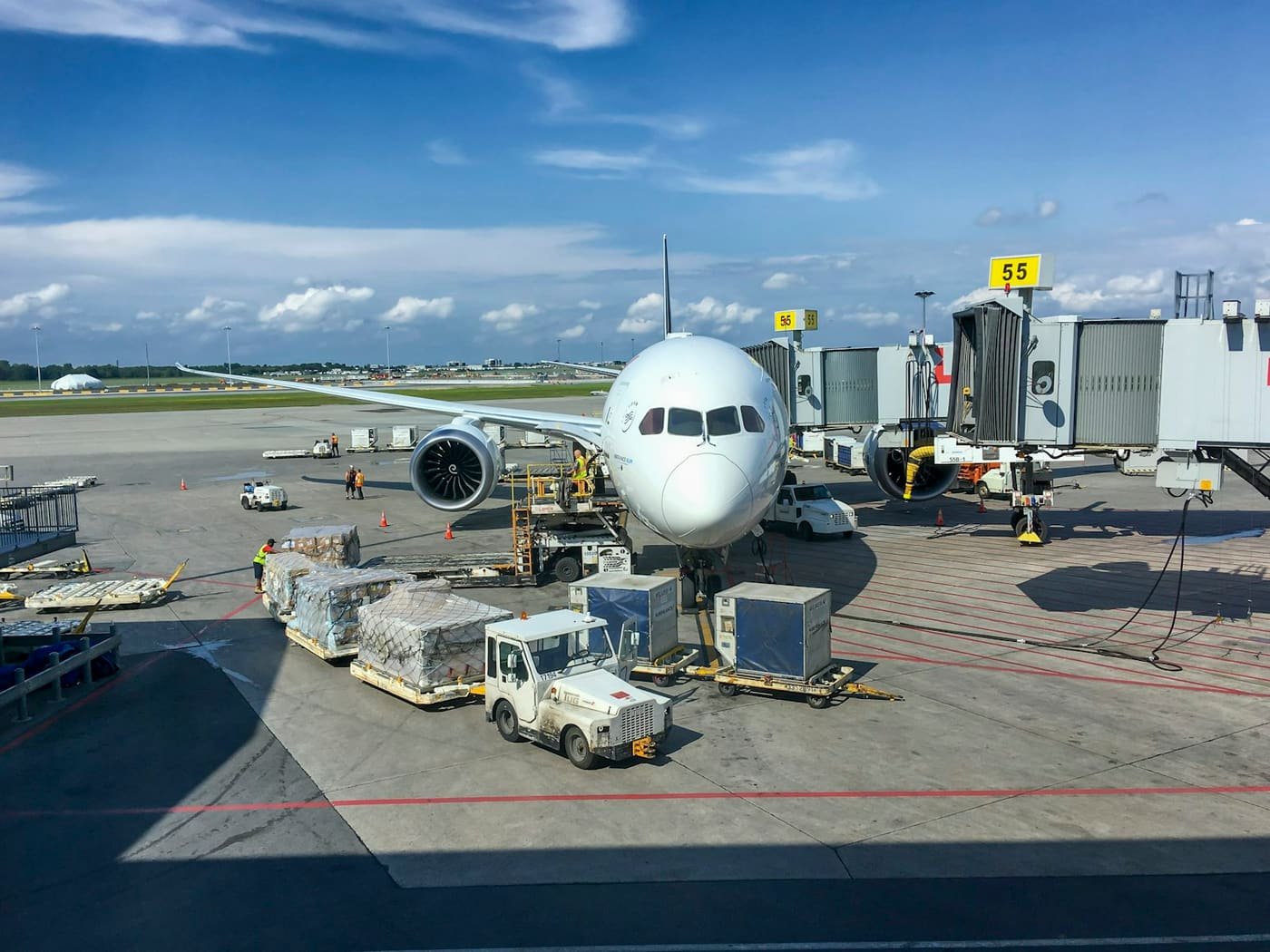
Both modes have cut-offs, handling points and a chance of delay, and both need insurance. Air cargo is built up on unit load devices, which IATA defines as either an aircraft container or a combination of an aircraft pallet and net, designed to be restrained directly by the aircraft's cargo loading system. Sea cargo travels in a standard container that is lashed on the vessel. Packing for air has to survive build-up and a tight flight schedule, while packing for sea has to survive stacking and a longer voyage.
Carrier liability also differs. For air, the Montreal Convention limits the carrier's liability for cargo to a fixed number of Special Drawing Rights per kilogram, unless the consignor makes a special declaration of interest in delivery and pays a supplementary sum (Article 22(3) of the Convention). Do not assume the carrier's liability will cover the value of your goods in either mode. Insure them, and see our guide to shipping high-value goods for the air-freight detail.
Paperwork Compared
By air, the transport document is the air waybill, which IATA describes as the contract of carriage between the shipper and the airline. By sea, it is the bill of lading. The remaining import documents are the same. India's Foreign Trade Policy 2023 lists the transport document, a commercial invoice cum packing list and the bill of entry as mandatory for imports, whichever mode you choose. Freight is also part of the customs value: Section 14 of the Customs Act includes, as the rules specify, the cost of transport to the place of importation and insurance, so the higher freight cost of air can raise the value on which duty is calculated, a small effect that is easy to forget.
A Five-Question Decision Guide
- What does a day of delay cost? Multiply it by the days air saves and compare it with the extra freight.
- How dense is the cargo? Below about 167 kg per cubic metre you pay for volume, so packing decides the bill.
- How large is freight next to the goods' value? If air would add a large share of the goods' value, the case for it needs a strong reason.
- How firm is the deadline? A fixed launch date or a contract penalty favours air. A flexible date favours sea.
- Can you split the order? Sending only the urgent part by air often costs far less than flying everything.
Hybrid Strategies
Many importers use both modes. They fly a first batch to start selling or to restart a line, and send the rest by sea. They fly samples and prototypes, and ship production quantities by container. They keep a small safety stock to reduce how often they need air at all. Our guide to the best shipping methods from China to India shows how to match the method to the cargo.
Common Mistakes
- Comparing air and sea on the freight rate alone and ignoring the value of time.
- Quoting air on actual weight when the volumetric weight is higher.
- Flying bulky, low-value goods because a deadline was missed, instead of planning earlier.
- Forgetting that customs, duty and delivery still take time after an aircraft lands.
- Assuming liability limits cover the value of the cargo.
Compare Both Modes With RR Brothers and Logistics
RR Brothers and Logistics can quote air freight and sea freight for the same cargo so that you can see the cost per unit side by side. Send us your cargo details with the packed dimensions, the weight and the date you need the goods.
Frequently Asked Questions
Speed and pricing basis. Air has a short main leg and is priced on chargeable weight. Sea has a long main leg and is priced per container, or per cubic metre or tonne for shared containers.
Per unit of cargo it usually costs more, but the total picture includes the value of time, stock held in transit and sales protected. Calculate both for your own cargo before deciding.
IATA says carriers can charge by volumetric or actual weight and use the higher for pricing, with volume in cubic centimetres divided by 6,000 as the general rule. Sea is priced by container or by cubic metre or tonne.
Because air charges the higher of actual and volumetric weight. Bulky, light cargo is charged on its volume, so the cost per unit rises sharply while the weight stays the same.
The import process is the same. The importer presents a bill of entry under Section 46 of the Customs Act, and the mandatory documents are the transport document, the invoice cum packing list and the bill of entry.
Yes. Many importers fly the urgent part and ship the rest by sea, as long as each shipment has its own packing list, documents and booking.
Sources
- IATA: Air cargo tariffs and rules (volumetric weight and pricing)
- IATA: What is an aircraft ULD in air transport?
- IATA: e-freight and the air waybill
- Convention for the Unification of Certain Rules for International Carriage by Air (Montreal Convention 1999), full text
- CBIC: Customs Act, 1962 (Sections 14 and 46)
- DGFT: Foreign Trade Policy 2023, Chapter 2 (para 2.06, mandatory documents)
This article is general information, not legal, tax or customs advice. Rules, rates and procedures change; confirm current requirements with the relevant authority or a licensed customs professional before you ship. Regulatory references were checked against the official sources listed above on 25 October 2026.
Image credits: header photo by Toni Pomar on Unsplash. Used under the Unsplash License.
Request a Quote
